Pipewright builds, releases, runs and watches models on Google Cloud from one file per use case. Private by default, a person in every decision that matters, and evidence for every model.
YAML, checked offline
ML teamPinned by digest, verified
CITrain, judge, score
LauncherDrift and performance
MonitorApprove, decline, snooze
PeopleEvidence pack, write-once
AuditClear ownership is the point: the platform team runs the cloud, ML teams own their models, approvers decide, auditors read the record. Nobody does someone else's job.
A use case is a folder: your pipeline code, plus YAML for data, training, gates and monitoring. Pipewright does the rest.
evaluation: primary_metric: auc gates: - { metric: auc, min: 0.75 } - { metric: calibration_error, max: 0.05 } champion: { enabled: true, min_improvement: 0.005 } slices: [contract_length_months] $ pipewright release --env prod --usecase churn verified: contract v3 is valid verified: training and inference templates match live: churn -> 67d2e88a
A Terraform blueprint stands up a private environment; teams join by name. One shared launcher serves them all, each with its own identity and data.
spec: blueprint: private-managed region: europe-west2 policies: promote_model: manual retraining: { required_approvers: [model-risk] } approver_groups: model-risk: { members: [group:model-risk@yourco.com] } tenants: retention: { landing_prefix: incoming/retention/ } fraud: { landing_prefix: incoming/fraud/ } guardrails: vpc_sc: { mode: enforce }
When a model drifts you get a short decision pack by email. The email never approves anything: you decide with your own identity, and the record keeps your reason.
Case rc-20261007-c3d3ac: churn (prod), drift Drifted: tenure_months 3.035, monthly_charges 0.853 Data checks passed. Champion v1, 1 day old. Approvers: ml-leads (done), model-risk $ pipewright retrain approve --case rc-20261007-c3d3ac \ --reason "real shift after the migration" approve sent as approver group model-risk recorded: case is approved training submitted on the chosen window
Every approval and deployment produces an evidence pack: what was trained, on what, how it was judged, who approved it, how it runs and how it is watched. Hashed, and stored write-once.
evidence.json controls, lineage, approvals report.md for people contract.json the release that trained it model_card.md intended use, limits evaluation.json metrics, gates, champion events.json every lifecycle event audit.json who changed or used it SHA256SUMS written last 12 pass · 1 info · 2 n/a · 0 gaps
The core does the MLOps. Enterprise adds what regulated customers need around it: private networking, audit evidence, and Fluxor beside you.
The private-managed blueprint stands up an environment with every guardrail on. Pipelines, models and endpoints all run in your own project, encrypted with your keys.
Drift opens a decision case, not a retrain. Training starts only when every required group has approved.
Contract, features, training, gates, triggers and monitoring declared, and checked against each other. Features are named, not queried.
Write-once contracts, digests everywhere, rollback in one command.
Lifecycle and decision events on Pub/Sub and in structured logs: route them to Slack, PagerDuty, a SIEM, or your own apps.
Produced automatically on every approval and deployment, and kept write-once for as long as your regulator asks.
When drift or a performance drop opens a case, the people your team names get the facts in a few lines: what moved, by how much, the trend, the data checks, the champion and what retraining would use. Every step after that is sent again, so nothing is decided in silence.
retraining.decisions.notifychurn (prod) drifted, and a person needs to decide what happens next. Nothing will retrain until the required groups approve.
| Drifted | tenure_months 3.035, monthly_charges 0.853 |
|---|---|
| Predictions | PSI 1.253 |
| Trend | worst PSI 0.01, 1.04, 3.03 over recent runs |
| Performance | not judged yet: 0 labelled rows |
| Data checks | passed: 1,000 rows, most nulls total_charges 1.5% |
| Champion | version 1, trained 2026-10-06 |
| Approvers | ml-leads, model-risk |
Review the full decision pack, then decide with your own identity:
pipewright retrain show --env prod --usecase churn --case rc-20261007-c3d3ac
View case rc-20261007-c3d3ac
pipewright retrain; every decision is recorded with your name and reason. You receive this because you are in retraining.decisions.notify for churn.Each control states what was checked and the facts it rests on: the job, the key, the identity, the approval, the decision. When a source cannot be read, the pack says so.
EV-01Model artifacts encrypted with a customer-managed keypassEV-02Training ran encrypted, in the private networkpassEV-03Training ran as the tenant's runner identitypassEV-04Trained from a released, pinned contractpassEV-05Evaluated against acceptance criteria and the championpassEV-06Promotion to the default version is approvedpassEV-07Deployment recorded and encryptedpassEV-08Monitored for drift and performancepassEV-09Key enabled and rotated at least every 90 dayspassEV-10Changes to the model and its endpoints are audit-loggedpassEV-11Data subject erasure requests handledinfoEV-12Every drift alert has a recorded human decisionn/aEV-13Ray clusters ran encrypted, in the private network, as the runnerpassEV-14Features came from the team's own feature datasets, as of each row's cut-offpassEV-15A promoted model is the tested, approved model, unchangedn/apipewright promote carries a tested release, and the model you approved, from test to production. Nothing is rebuilt. Every artifact passes four checks at the border, and anything that differs from what you tested is turned back.
test sha256:6d978a1f617ef908a46d2703fe48bf51…
prod sha256:6d978a1f617ef908a46d2703fe48bf51…
identical
model files
test 6 of 6, the approved v5
prod 6 of 6, unchanged since promotion (EV-15)
verified
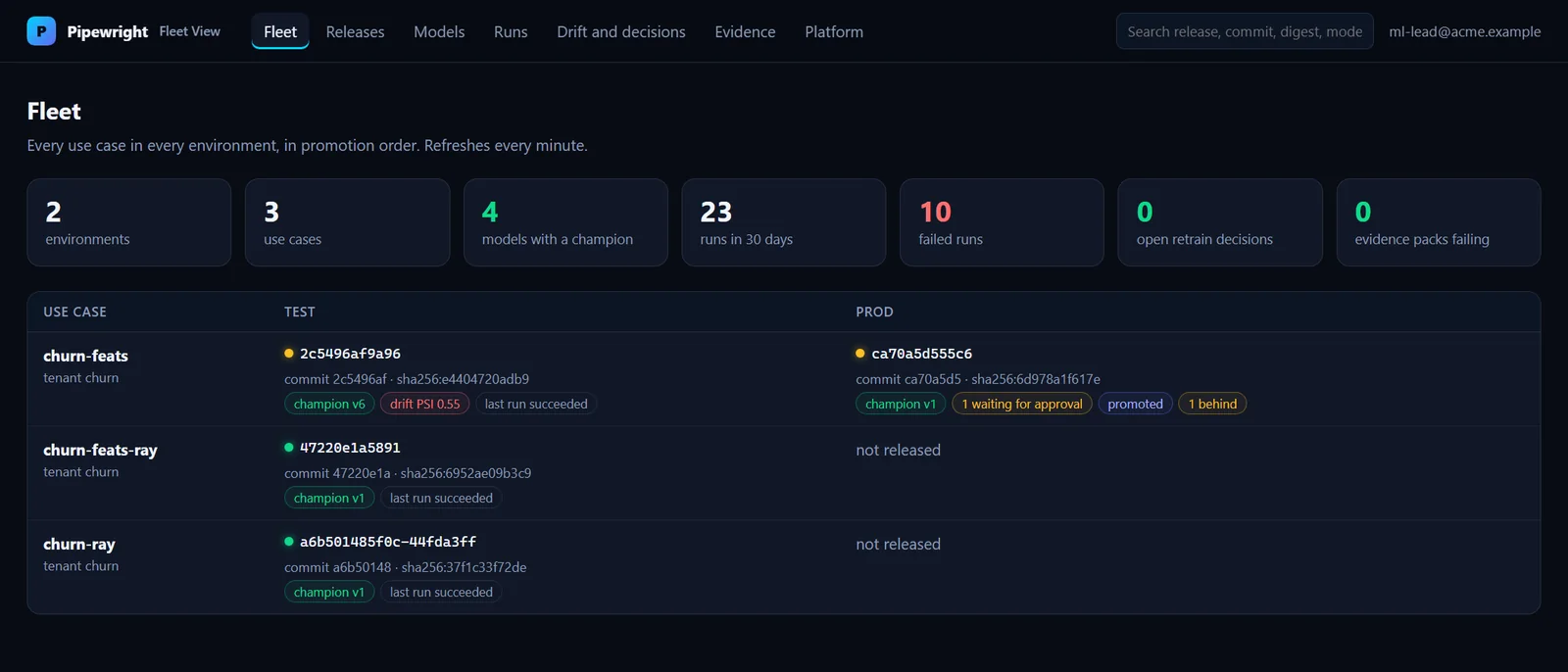
training: container.resources only in the destination. Nothing was promoted.v6 is not the default (approved) version in test: approve it there first.approvals.promote_model: auto is not allowed in prod (platform policy)Platform teams, ML leads and model risk see the whole fleet at once: what is live where, which models wait for a decision, what drifted, what failed, and whether every control holds. Fleet View changes nothing; it shows what the platform already records.
Pipewright is available today through early access, running on your own Google Cloud with Fluxor alongside you. The core will be released as open source later. Enterprise adds private networking, audit evidence and support from Fluxor.
| CoreOpen source later | Enterpriseby Fluxor Software | |
|---|---|---|
| CLI, configuration model and examples | ✓ | ✓ |
| Shared launcher and write-once release contracts | ✓ | ✓ |
| Monitoring, alerts and lifecycle events | ✓ | ✓ |
| Retrain decisions with approver quorum | ✓ | ✓ |
| Ray on Agent Platform steps: a cluster per run, within platform limits | ✓ | ✓ |
| Promotion between environments: the tested release and approved model, by digest | ✓ | ✓ |
| Features from feature tables and Feature Store groups, point in time | ✓ | ✓ |
| Private-managed blueprint (CMEK, VPC-SC, internal launcher) | - | ✓ |
| Approver groups, decision feeds and policy limits, provisioned | - | ✓ |
| Ray provisioned: Private Service Connect, CMEK and the identities, from one switch | - | ✓ |
| Feature governance: datasets granted per team, features required, evidence of every read | - | ✓ |
| Promotion across private projects: grants, perimeter rules, evidence it arrived unchanged | - | ✓ |
| Keyless CI into private environments: Workload Identity Federation, admitted through the perimeter by identity | - | ✓ |
| Evidence packs and the evidence worker | - | ✓ |
| Fleet View: every environment, team and model in one read-only view | - | ✓ |
| SIEM and observability exports | - | ✓ |
| Support, onboarding and platform build-outs | Fluxor (early access) | Fluxor |
No. Pipelines stay plain Kubeflow Pipelines code. Pipewright compiles them, supplies the parameters, identities and outputs, and releases them. The examples show the conventions.
No. Pipewright runs inside your project: pipelines, models, endpoints, monitoring and evidence all stay there, encrypted with your keys. In the private blueprint nothing is reachable from the internet.
Not unless you ask it to. By default drift opens a decision case for people to approve, decline or snooze. A "candidate" mode trains a challenger automatically but never promotes it without a person.
By promotion, not by building it again. pipewright promote takes the release you tested, and the model you approved, to production: images copied by their digest, pipelines checked against the tested ones, the model's files verified one by one. Production's own policies apply first, and a production approver still decides when the model starts serving. Anything that differs from what was tested is refused, and every promotion is recorded and can be rolled back without rebuilding.
Yes. A use case names the features it needs, from BigQuery feature tables or groups registered in the Agent Platform Feature Store, and Pipewright reads each value as it was at the row's cut-off, so nothing from the future reaches training. Batch scoring reads features the same way. Your features stay with their owners: Pipewright copies nothing, and your platform team decides which feature datasets each team may read. Every model's evidence records exactly which features it trained on.
Yes, in the environments where you train. A step asks for a Ray on Agent Platform cluster in its YAML and gets one for that run only, sized within limits your platform team sets. Pipewright creates it with your keys and network, runs the step's Ray job on it and deletes it afterwards, so nothing is left running. Ray needs the VPC Service Controls perimeter in dry run, so it runs in development and test, while production keeps its perimeter enforced and receives the models you trained there by promotion. While developing, data scientists keep their own standalone clusters for notebooks; pipelines never depend on them.
Yes, with Fleet View in Enterprise. One read-only screen shows every use case in every environment: the live release and its digest, the champion and the candidates waiting, run failures, drift and retrain decisions, the evidence controls and each environment's security posture. A collector reads metadata only, never your data, and each viewer signs in with their Google identity and sees only their own teams.
Not yet. Today Pipewright is available through early access, set up on your own Google Cloud with Fluxor. The core will be released as open source later; Enterprise features stay with Fluxor.
Google Cloud only, on Agent Platform Pipelines today. A GKE-based blueprint with Kubeflow Pipelines is planned.
With their own Google identity. Approver groups are registered by the platform team; membership is checked by Google Cloud IAM, and every decision is recorded with the person's name and reason.
From YAML to a monitored model with an evidence pack, in your own Google Cloud project.